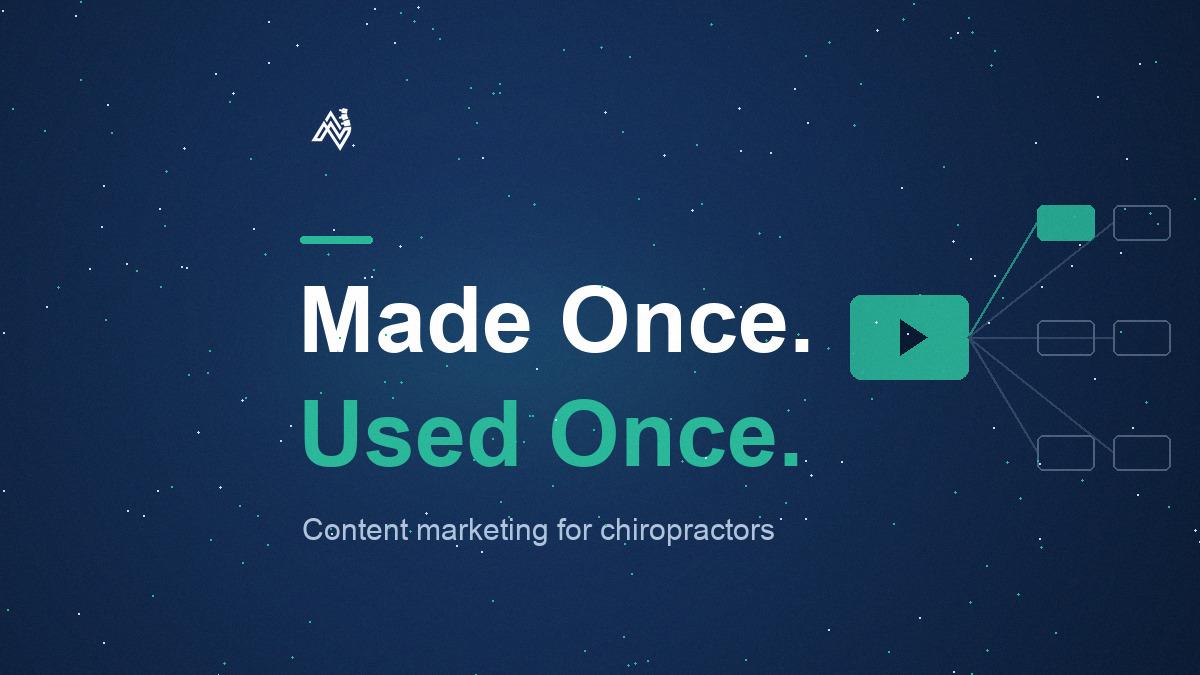
Most clinics treat content marketing for chiropractors as a posting obligation: something has to go up this week, so something goes up. The result is a feed full of material made once, used once, and forgotten by the following Tuesday.
This is what clinic content is actually for, which questions deserve answering first, how one recorded answer becomes a month of material, who should make it, and how to tell whether any of it is doing anything.
Table of Contents
What Content Marketing for Chiropractors Is Actually For
Strip away the vocabulary and the job is narrow.
It answers the questions that stop someone booking
A prospective patient rarely lacks information about chiropractic in general. What they lack is confidence about your clinic specifically: whether it suits their problem, what the first visit involves, whether it will be uncomfortable, what it costs, and whether the person treating them seems like someone they would trust. Every one of those is a question, and every unanswered question is a small reason not to call.
Good clinic content removes those reasons one at a time. It is closer to a well-run front desk than to advertising, and it should be judged the same way: did it make the next step easier?
Why it is not the same job as social posting
Social posting is one place content appears; it is not the content itself. A post has a life measured in hours. An answered question on your website, a short film explaining the first visit, or an email to patients who stopped coming can keep working for years. Treating the two as the same job is why so many clinics produce a great deal and accumulate nothing.
The difference compounds. A clinic that answers two questions properly each month has two dozen permanent answers after a year, each one findable, linkable and ready to send to the next person who asks. A clinic that posted every day for the same year has a feed nobody scrolls back through. Both did real work. Only one of them built something.
The Questions Worth Answering First
The best content marketing for chiropractors starts with what you already hear at the front desk. It is the most reliable research you will ever get, and it costs nothing.
What people ask before they call
- Is this right for my problem? Specific to the complaints you actually see most.
- What happens at the first visit? Step by step, including how long it takes and what to wear.
- Will it hurt? Asked constantly, and rarely answered on clinic websites.
- What does it cost, and do you take my plan? The last thing checked before booking.
- Who will I see? A face and a voice settle this faster than a biography.
The simplest way to build the list is to ask reception to write down every question they are asked for two weeks, in the caller's own words rather than tidied up. The exact wording matters. It is how people phrase the question to a search engine or an AI assistant, and an answer that uses their words is far easier for them to find than one written in clinical language.
What they ask after the first visit
The second set gets neglected because it arrives after the booking. How many visits will this take, what should I do between appointments, why does it feel different this week. Answering these well does not win new patients directly. It keeps the ones you have, and it gives current patients something to forward to people they know, which is the most trusted introduction a clinic can get.
Film Once, Use It Everywhere
The economics of clinic content change completely once you stop making each piece separately.
Why video is the best source material
A practitioner answering a question on camera for two minutes produces more usable material than any other format. It captures the words, the tone and the face at once. Writing can be taken from video; video cannot be taken from writing. That asymmetry is the whole argument for recording first and writing second.
It also solves the voice problem. Patients choosing a chiropractor are choosing a person, and an article in a generic house style tells them nothing about who they will meet. Two minutes of that person explaining something clearly tells them a great deal.
The production bar is lower than most practitioners fear. A recent phone, a quiet room, light from a window in front of the speaker rather than behind, and one question per take will produce usable material. Talking through an answer from a short list of points reads far more naturally than reciting a script, and a few stumbles are fine because they get edited out. What matters is that the answer is clear, specific and recognisably yours.
What one recorded answer turns into
- A full-length answer on your website, where it can be found for months.
- Two or three short clips for social, each built around a single moment.
- A written version of the same answer, which becomes a page or a chiropractor blog post.
- A still image with one line lifted from the transcript.
- An email to existing patients likely to have the same question.
- An FAQ entry on the page where the question naturally comes up.
One recording session covering a handful of questions can supply a month of material across every channel, all in one consistent voice. That is the efficient version of content marketing for chiropractors, and it is close to the opposite of inventing something new for each channel every week.
It also keeps everything consistent. When the clip, the written page, the email and the FAQ entry all come from the same recording, they cannot contradict each other, and written chiropractic articles taken from real answers read like the practitioner rather than like a template.
Who Should Make It
The answer is less obvious than choosing between hiring someone and doing it yourself.
The practitioner's voice is the asset
Nobody outside the clinic can supply the one thing that makes clinic content persuasive, which is the practitioner explaining something they explain every day. Scripts help, and editing helps a great deal, but the substance has to come from the person patients will actually see. Content written entirely by someone who has never spoken to a patient reads that way, however polished it is.
Keep patients out of frame unless they have agreed in writing. Anything that could identify a patient, including a face, a name, or a treatment room detail that makes them recognisable, needs their explicit permission, and the simplest approach is to build content around the practitioner explaining rather than around patients being treated. It is also the more persuasive choice, because the question a prospective patient is really asking is who they will be seeing.
What an agency can and cannot supply
A content marketing agency for chiropractors is genuinely useful for the parts clinics find hardest: choosing which questions to answer, running a recording session efficiently, editing, cutting clips, and turning one recording into many assets. It cannot supply the expertise or the face, and one that offers to replace both with a library of generic material is selling volume. The difference between production and scheduling is the question to settle before signing anything.
One further point applies to any video marketing agency for chiropractors: the raw recordings should be delivered to you, not only the finished clips. Raw footage is where the next month of material comes from, and an arrangement where the agency keeps it means every future piece has to be bought again.
Want us to do this for your clinic?
See the quality before you spend a dollar. Tell us about your clinic and we send a clear monthly price for the videos you need, within one business day, so you can judge the fit on your own practice rather than on our promises.
Get a quote →How Much Is Enough
Less than most clinics attempt, done more consistently than most manage.
Consistency beats volume
A small number of genuinely useful pieces, published on a rhythm you can sustain, will outperform a burst of activity followed by silence. The burst is the most common failure in content marketing for chiropractors: a month of daily posts, then nothing for a season, which leaves the page looking abandoned at exactly the moment someone checks it before calling.
The other quiet failure is writing for the wrong audience. Content full of technique names and clinical terminology is content written for other chiropractors, and it tends to get praise from colleagues and silence from patients. Test every piece against one reader: someone who has never been to a chiropractor, is slightly nervous about it, and wants to know whether you are the right person to see.
A realistic rhythm
For most practices, one recording session a month is enough. In practice, a month tends to look like this:
- First week. Record four or five answers and publish the full versions on the website.
- Second week. Release short clips cut from those answers.
- Third week. Post stills with a single line each, and send one email to existing patients.
- Fourth week. Add the answers as FAQ entries where the questions naturally arise, and collect questions for next month.
Each step reuses the same recordings. That is a manageable commitment for a busy clinic, and it produces a steady, connected stream of material rather than a pile of disconnected posts.
If search is part of the plan, the written versions matter more, because they are what gets found. How search actually works for a local clinic covers which of those pages deserve the most attention.
Knowing Whether It Works
Content is slower to show its value than advertising, which makes it easy to judge on the wrong numbers.
The signals that mean something
- New patients mentioning it. Ask how people found you and what made them call. Content shows up here first.
- Fewer repeated questions at the desk. If the first-visit film is working, reception hears that question less often.
- Pages being found. Whether your written answers start appearing for the questions they answer.
- Material worth paying to distribute. The pieces that do well organically are the ones worth putting behind paid social.
Give it a season before judging. Advertising produces enquiries within weeks; content builds more slowly, because each answer has to be published, found and encountered at the moment someone is deciding. Three months of steady output is a fair first test. Three weeks tells you almost nothing.
What to stop measuring
Likes, follower counts and posting frequency are easy to count and say almost nothing about whether content is helping people book. A clinic can grow all three while its schedule does not move. The honest test of content marketing for chiropractors is whether it made the decision to call easier for someone, and the people best placed to tell you are the patients who just did.