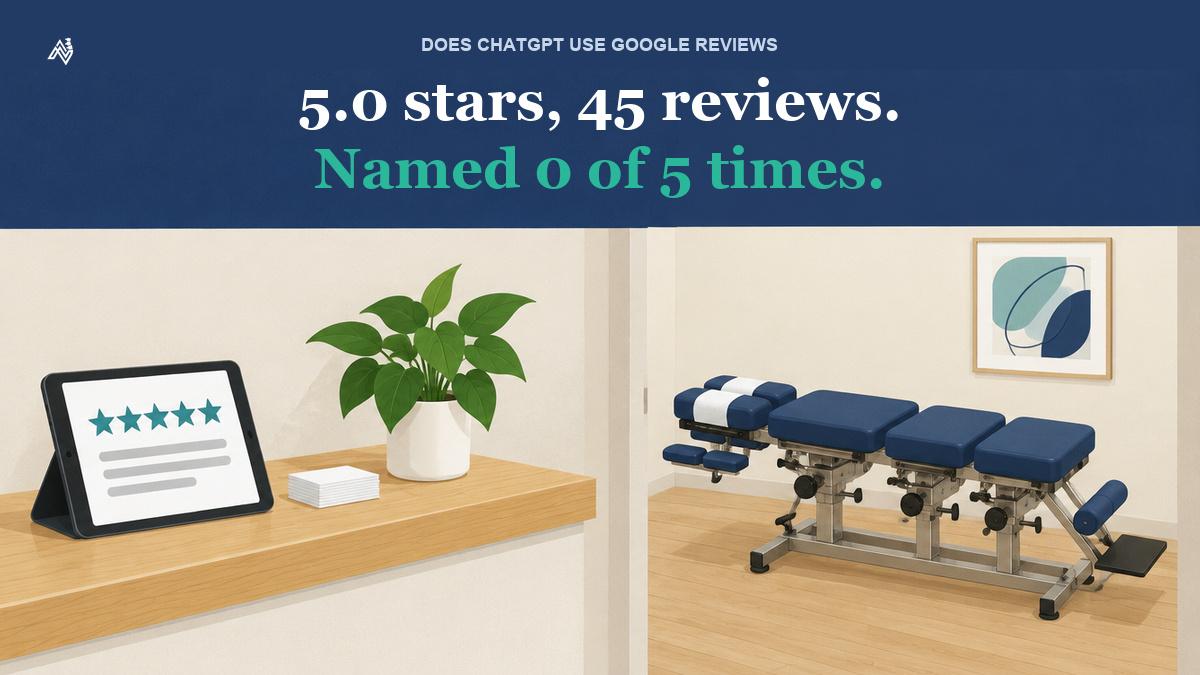
Does ChatGPT use Google reviews? We can't see what it reads, but in our test a perfect rating was not enough by itself. In Plano, Texas, on October 25, 2026, ChatGPT named the same clinic in 5 of 5 answers and never named a 5.0-star clinic with 45 Google reviews (ChiroVant's own ChatGPT runs).
Stars and proof are different things. A rating tells a patient how past visits went. It says much less about what your clinic treats, who it helps and where else your name shows up online, and those are the things an AI answer has to put into words. Reviews still count. They are one piece of the proof, not the whole of it.
We are ChiroVant, the team behind 183 films built for chiropractic clinics. This guide is written for you, the clinic owner: what our runs showed, where Google Maps fits, what a useful review says and how to ask for one inside Google's rules. If you would rather see your own city first, run the ChatGPT test for your clinic.
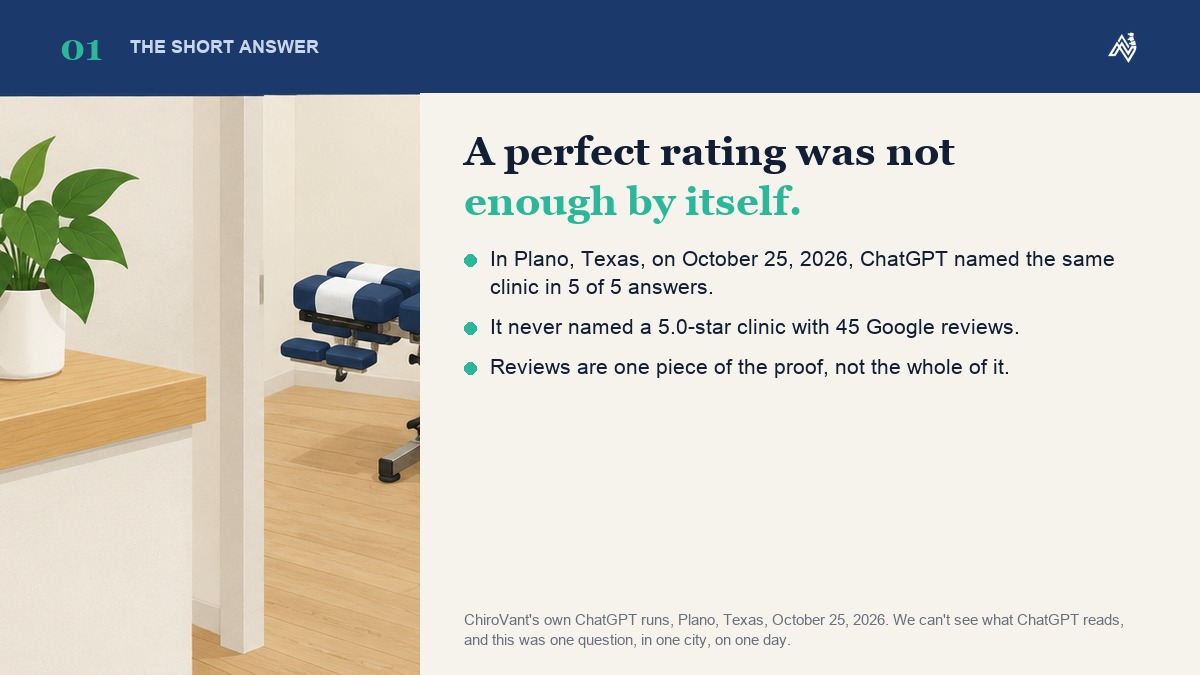
Table of Contents
- → Does ChatGPT Use Google Reviews? What Our Plano Runs Showed
- → Where Do Google Maps Listings Fit in ChatGPT's Answers?
- → If Stars Are Not Enough, What Proof Can an AI Answer Find?
- → What Should Your Reviews Say, and How Do You Ask for Them?
- → What Does ChiroVant Do for Clinics That Want More Proof Online?
Does ChatGPT Use Google Reviews? What Our Plano Runs Showed
Nobody outside OpenAI can say for sure, but a strong rating did not decide the answer in our runs. On October 25, 2026, ChiroVant asked ChatGPT five times for the best chiropractor for sciatica in Plano, Texas. It named the same clinic all five times. A clinic with a 5.0-star rating and 45 Google reviews appeared in none of them.
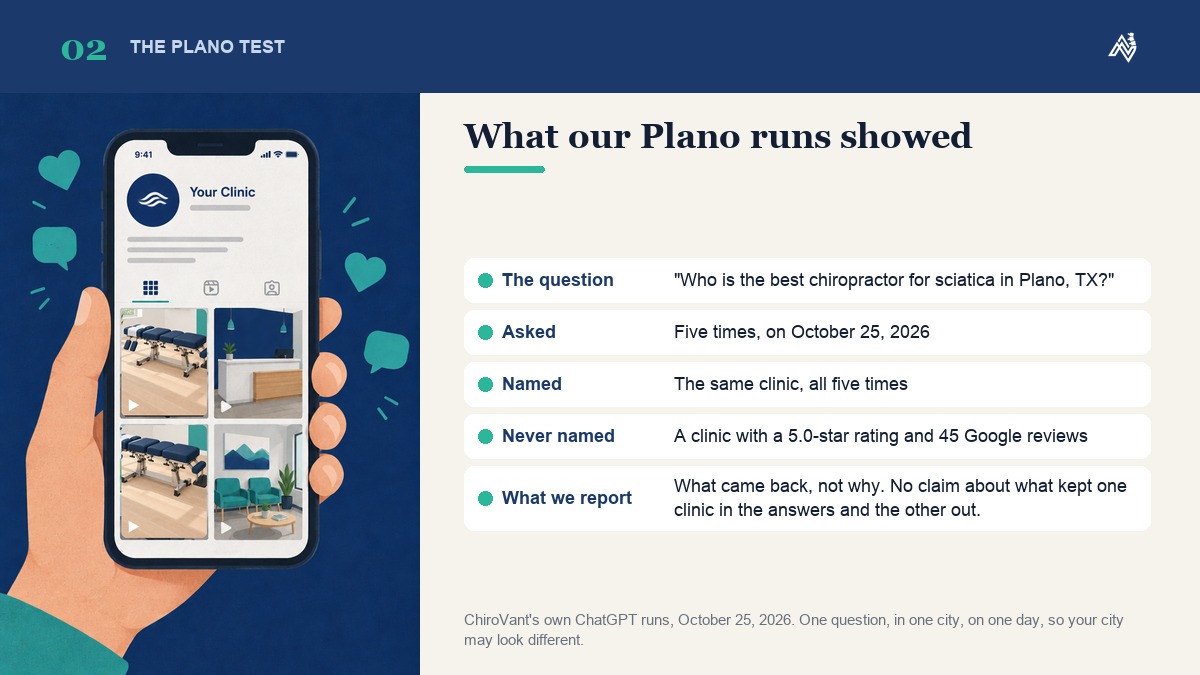
The question we typed was "Who is the best chiropractor for sciatica in Plano, TX?" A patient could type the same words tonight. We report what came back, not why, and we make no claim about what kept one clinic in the answers and the other out.
For your clinic, the lesson is narrow. A high rating is worth protecting, because patients read it, but in this test it did not settle the answer on its own. And this was one question, in one city, on one day, so your city may look different. Our guide on how to ask ChatGPT five times and read the answers shows the manual method step by step.
Where Do Google Maps Listings Fit in ChatGPT's Answers?
A smaller part than many owners expect. In 24 ChatGPT answers ChiroVant collected on October 29, 2026, Google Maps listings were a source in only 4. Most of those answers were built from third-party lists, directories and businesses' own websites. Those 24 answers replied to clinic-owner questions, not patient searches, so read them as a pattern, not a rule.
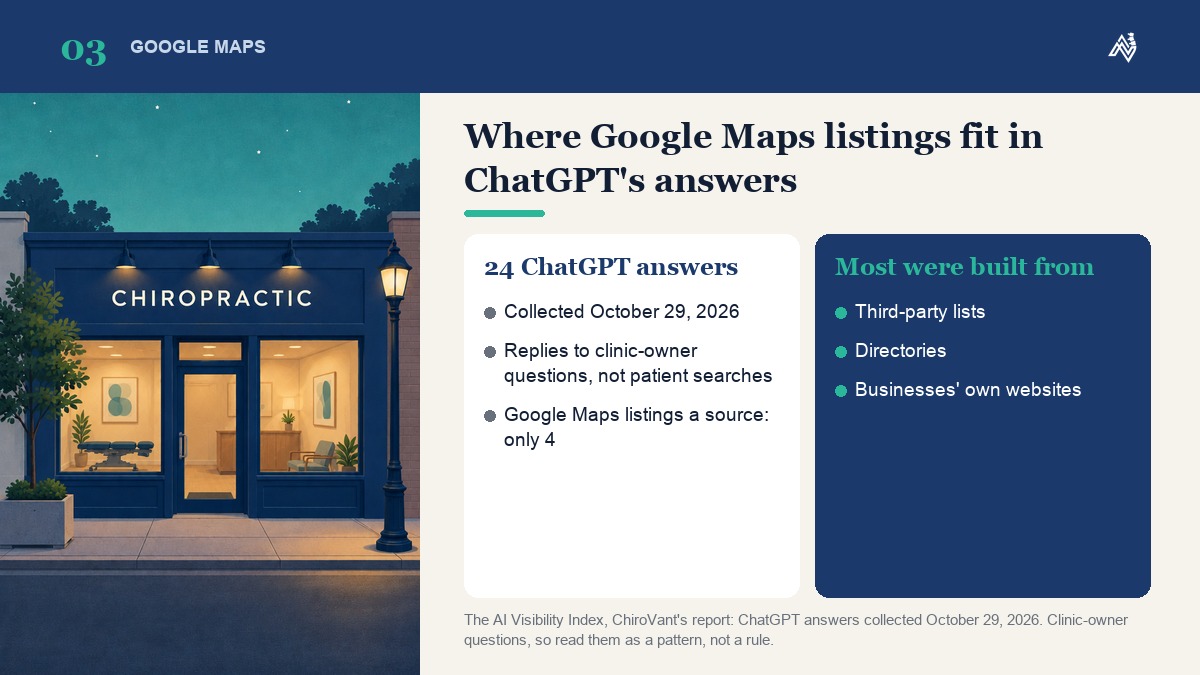
That finding is part of The AI Visibility Index, ChiroVant's report on how ChatGPT and Google's AI Overviews answer local questions. For a clinic, the takeaway is simple. Your Google profile is one place an AI answer can draw on, and your reviews live there. The other places are pages you own or can be listed on: your website, local directories and published lists of clinics in your area.
If your website says little about the conditions you see, or your clinic is missing from local directories, the star count on Maps is left to carry the whole load. Keep the profile current anyway, because patients see it in Search and Maps: hours, services, photos and regular posts. Our guide to Google Business Profile posts has a monthly routine you can hand to your front desk.
Want us to do this for your clinic?
Want to see who ChatGPT names in your city? The AI Visibility Report asks ChatGPT about clinics in your city, shows who gets named and compares your Google rating with nearby clinics. It costs nothing, and it builds while you watch two short lessons.
Get my report →If Stars Are Not Enough, What Proof Can an AI Answer Find?
Proof of what you treat and for whom, spread across places that point to each other. We group it in four parts we call the Proof Stack: Hook, Study, Story and Search. Reviews sit inside Search, next to your own articles and your Google profile. In our view, each part does more when it links to the others.
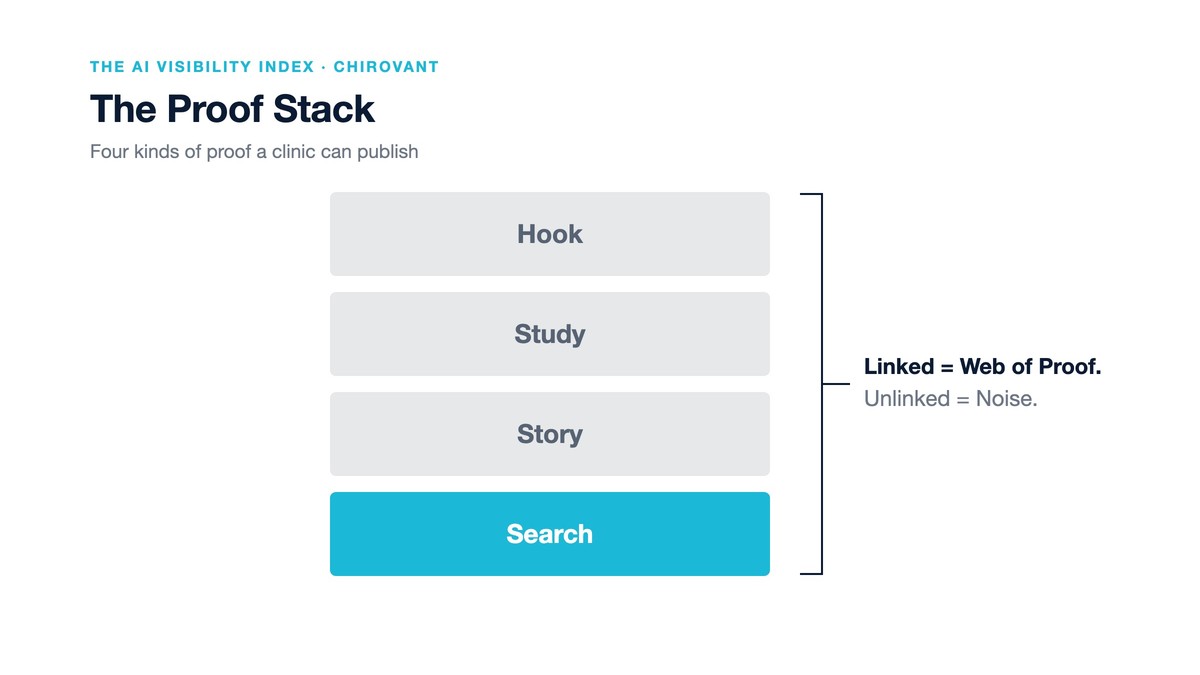
A star rating is one number. It can't say which conditions you see, who your doctors are or what a first visit involves, and it can't show that your website, your directory listings and your Google profile describe the same clinic. Those details live on your own pages, in short videos that answer patients' questions and in the local directories that list you. Reviews add the patient's side of that picture.
So the useful question is not how to add one more star. It is whether a stranger, or a machine, could read your profile, your site and your listings and come away with one clear idea of what you treat and where. We can't promise that this gets a clinic named, and we don't claim it caused anyone else to be named. It is simply proof a patient can check.
It is also work you own, so it stays up when the ad budget is off, as our guide on what keeps working when ads pause explains.
What Should Your Reviews Say, and How Do You Ask for Them?
Reviews should describe a real visit in the patient's own words, and you can't choose those words for them. Ask every patient the same simple way. Never pay or offer a discount for a review, never ask only the patients you expect to be happy, and never tell patients what to include. Google's Maps policy rules out all three.
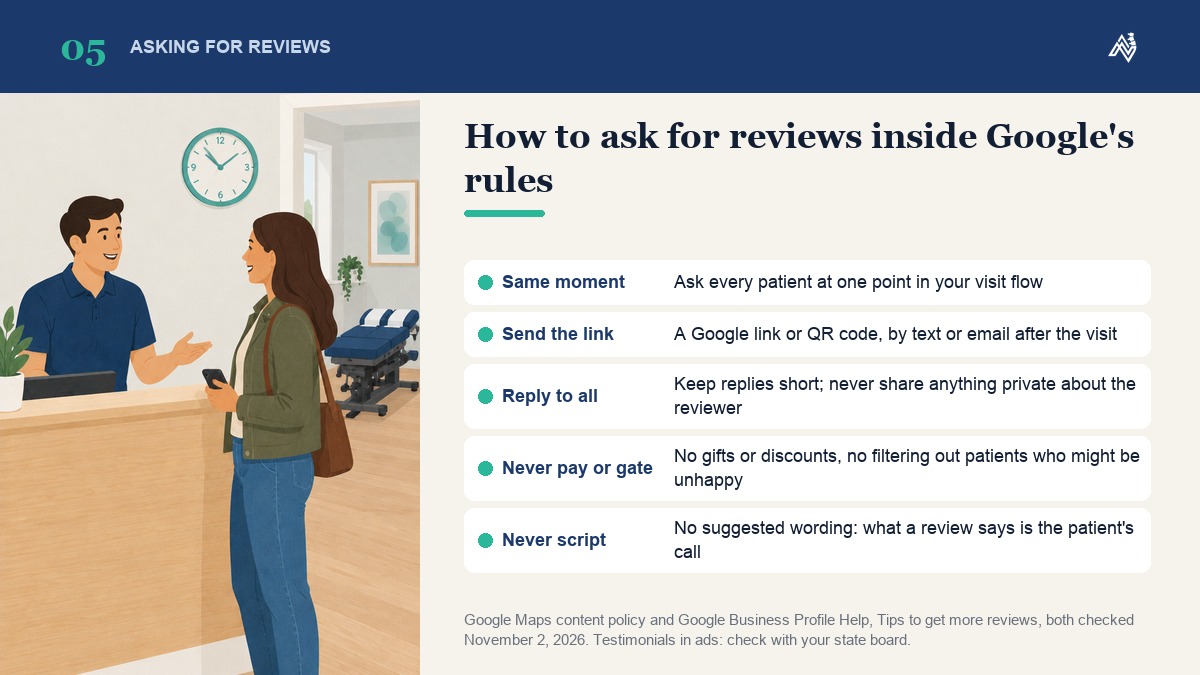
Google's Maps content policy, checked on November 2, 2026, lets a business ask for reviews of a genuine experience if it offers no incentive and does not try to influence the rating or the review. The same policy says merchants should not request that specific content be included, and should not pressure people to leave a review while they are on the premises. So what a review says is the patient's call. What you shape is the visit itself and the way you ask.
A routine that stays inside those lines:
- Same moment, every patient. Pick one point in your visit flow, such as the end of a care plan, so nobody on your team decides who gets asked.
- Send the link. Google's tips to get more reviews, checked on November 2, 2026, suggest asking customers to visit a Google link or scan a QR code. A text or email after the visit works, with no one standing over the patient.
- Reply to every kind of review. Keep replies short and never share anything private about the reviewer. Google's same tips page notes that a mix of positive and negative feedback often feels more trustworthy.
- Never pay, gate or script. No gifts or discounts for reviews, no filtering out patients who might be unhappy and no suggested wording.
Using reviews as testimonials in your ads or on your website is a separate question with its own rules, so check with your state board before you do it. Our post on chiropractic advertising rules lists what to look at. For the full review routine, see our guide to Google reviews for chiropractors, and for everything a patient finds when they look you up, our guide to chiropractic reputation management.
What Does ChiroVant Do for Clinics That Want More Proof Online?
We focus on branding and content creation for organic growth: short branded videos, carousels and posts made with your logo, your services and your city. Videos are built from your website, so there is nothing to film. We produce with AI and review every piece by hand, and you approve every script before anything goes out.
That work feeds the Hook, Study and Story parts of the stack, and Authority adds local search work to the Search part. On Essential, at $249 a month, you get the content and post it yourself. On Growth, at $449, we post it for you once you have approved each piece. Authority, at $989, adds two local articles a month on your site and keeps your Google Business profile active, with review replies written for you. Every pack runs month to month, and the details are on our packs page.
Want us to do this for your clinic?
Start with your own city: see who ChatGPT names when someone asks for a chiropractor where you practice, how your Google rating compares with nearby clinics, your Proof Stack score out of 4 and three clear priorities. It costs nothing.
Get my report →This week, pick the one moment in your visit flow when every patient gets asked for a review, and write it down so the whole team asks the same way. Then run the ChatGPT test for your city to see which clinics it names today and where your clinic stands.