Most advice about keywords for chiropractors starts with a list of a hundred phrases and no explanation of which ones matter. That is backwards. Chiropractic search demand has an unusual shape, and once you see the shape, the list mostly writes itself and gets a lot shorter.
This is what patients actually type, with real monthly volumes attached, why the biggest number on any keyword report is the one you should worry about least, and how to turn the handful that matter into pages.
The figures throughout are US monthly search volumes from a Semrush export taken on 1 September 2026, covering 67,958 chiropractic-related terms. Difficulty scores are Semrush's own 0-100 scale.
Table of Contents
The Shape of Chiropractic Search Demand
Two features define this category, and both are unusual enough to change the strategy.
One search is nine times larger than the next
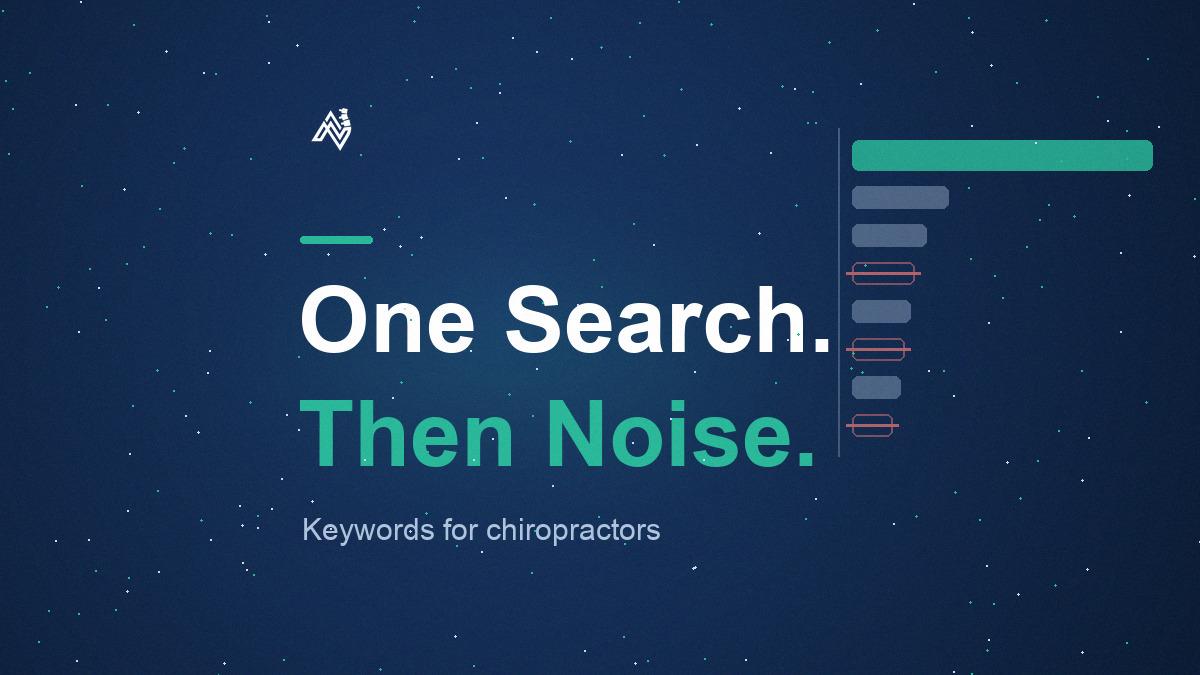
Proximity searching does not merely lead this category, it swallows it. Chiropractor near me runs at about 246,000 searches a month in the US. The next commercial term, chiropractors near me, sits at roughly 27,100. Everything else, including branded searches, condition searches and question searches, sits well behind both.
That concentration is the single most important fact about keywords for chiropractors, because it means the category is not won by breadth. A category where demand spreads evenly across hundreds of terms rewards whoever produces the most content, which is rarely a single practice. A category where it collapses onto one local question rewards whoever handles that one question best in one place, which a single practice absolutely can. The shape here is unusually friendly to small operators, provided they resist the urge to chase everything.
The tail is short, and much of it is not patients
Beyond the near-me cluster, volume drops away quickly, and a meaningful share of what remains is not prospective patients at all. Career searches, definition searches and curiosity searches sit alongside the commercial ones in every export, and a report ranked purely by volume will put several of them near the top.
The scale of that contamination surprises people. Chiropractor salary runs at about 9,900 a month, which is the same volume as walk in chiropractor near me. How to become a chiropractor is around 4,400. Chiropractor school is about 2,900. None of those people will ever book an appointment, and all of them will appear in a keyword tool looking exactly as attractive as the terms that matter.
Why Volume Is the Wrong Thing to Chase
This is where keyword reports mislead clinics, and it costs real money.
Local intent means proximity decides
The largest terms in this category are local-intent searches, which Google answers with a map of nearby businesses rather than with articles. No amount of content ranks a practice for a searcher on the other side of the city, because distance is a ranking input you cannot influence. The realistic objective is being the obvious choice inside your genuine catchment, which our guide to ranking for chiropractor near me works through in detail.
So a national figure of 246,000 tells you almost nothing about your opportunity. What matters is the fraction of it happening within a few miles of your door, and that is a much smaller and much more winnable number. It is also the reason the difficulty score on that term sits around 51 while sciatica chiropractor near me sits at 2.
Two searches that look identical and are not
The clearest illustration in the whole dataset is a pair of phrases almost nobody separates.
- How much does a chiropractor cost - about 2,900 a month. A prospective patient checking whether they can afford you.
- How much do chiropractors make - about 5,400 a month. Someone considering the profession as a career.
Nine words, one letter of difference in the verb, and opposite audiences. The career version has almost twice the volume. A tool sorting by volume recommends the wrong one, and a page written to capture both will convert neither.
💡 Pro Tip
Before adding any keyword to a plan, ask one question: if this person landed on my page, could they plausibly become a patient this month? Career searches, homework searches and out-of-area searches all fail that test regardless of volume. The keyword list that survives it is usually a quarter the size and worth several times more.
Get a quote →The Best Keywords for Chiropractors, With Real Volumes
Two groups carry the commercial weight. Neither is the one most clinics start with.
Proximity, and the qualifiers patients attach to it
The head term and its city variants come first, but the qualifiers are where the useful information sits. Patients rarely type the bare phrase when they have a preference. They add something, and each addition is a requirement stated out loud:
- Chiropractor near me - around 246,000, difficulty about 51. The prize, and the hardest.
- Best chiropractor near me - around 12,100. Reputation is the deciding factor for this person.
- Walk in chiropractor near me - around 9,900, difficulty about 15. Availability matters more to them than reputation.
- Female chiropractor near me - around 1,900. A preference a practice either meets or does not.
Collectively those qualifiers are the most honest description of your market you will get for free. A clinic that notices its area produces a lot of availability qualifiers has learned something about how to compete that no volume column would have told it, and the difficulty gap between the bare term and the qualified ones is where a smaller practice actually wins.
Read them as intelligence rather than as a page list, though. Chiropractor open now runs at roughly 170 a month nationally and chiropractor open on saturday near me at about 40. Those are real signals about what your market wants and terrible reasons to build a page. The right response to a Saturday-hours signal is Saturday hours, stated on the page you already have.
Condition plus location, where the competition thins out
Individually smaller, higher intent, and dramatically less contested. Can a chiropractor help with sciatica runs around 3,600 at difficulty 23. Add a location and the competition falls off a cliff: sciatica chiropractor near me is about 1,600 at difficulty 2, and chiropractor for sciatica near me about 1,000 at difficulty 1.
Those difficulty numbers are not typos. A practice with a genuine focus can win these searches almost uncontested, while the biggest clinic in town spends its effort on a term scoring 51. Neck pain behaves the same way. This is the most underrated group in the category and the one most clinics skip because the volumes look unimpressive next to the head term.
The Questions That Decide Whether Someone Books
The most overlooked keywords for chiropractors are not searches for a chiropractor at all. Before a patient chooses a practitioner, they check whether the profession is for real and whether they can afford it. Both carry serious volume and almost no competition.
The credibility questions
Are chiropractors doctors runs at about 12,100 a month at difficulty 19 - the same volume as best chiropractor near me, at a fraction of the difficulty. Are chiropractors safe and is chiropractic safe add roughly 2,900 and 2,400 more.
These are people deciding whether to trust the profession at all, and they resolve that question somewhere. A clinic that answers it plainly on its own site removes hesitation that would otherwise be settled somewhere less favourable, or not at all. We wrote the answer to that exact question because the volume justified a page of its own, and the same logic applies to whichever of these questions your own patients raise most.
The practical questions
Unglamorous, closest to booking, and routinely absent from clinic websites because they feel too basic to write down. They are also the easiest terms in the entire category:
- Chiropractor cost - around 4,400, difficulty about 8.
- How much does a chiropractor cost - around 2,900, difficulty about 9.
- How much is a chiropractor visit - around 2,400, difficulty about 5.
- Do chiropractors take insurance - around 2,400, difficulty about 4.
Four terms, roughly 11,700 searches a month between them, and not one scoring above 9 for difficulty. They are the last thing a hesitant person checks before calling, and publishing plain answers to them is the cheapest ranking available in this category.
Turning the List Into Pages
A keyword is not a page, and the commonest error in acting on keywords for chiropractors is assuming a one-to-one relationship.
Group by what the searcher wants
Chiropractor near me, chiropractor in your city, and best chiropractor in your city are the same person with the same need, and they belong on one strong page rather than three thin ones competing with each other. Sciatica in your city is a different person and deserves its own. The grouping question is not whether the words differ but whether the answer would.
One page per genuine intent
A page built to contain a keyword reads like a page built to contain a keyword, and both readers and search engines have become good at recognising it. A page built to answer a question completely will naturally contain the phrasings people use, because those phrasings are how the question gets asked.
For most practices the finished set of keywords for chiropractors comes out looking like this:
- One location page carrying the proximity cluster and its qualifiers.
- Two to four condition pages, only for what you genuinely treat, each paired with your area.
- Three or four question pages covering cost, insurance, safety and credentials.
- Nothing else, until those are working.
That is eight to ten pages. A dozen pages that each answer one thing properly will outperform sixty that each mention a keyword, and the shortlist above covers most of the commercial demand that is realistically winnable by a single clinic.
Want us to do this for your clinic?
See the quality before you spend a dollar. Tell us about your clinic and we send a clear monthly price for the videos you need, within one business day, so you can judge the fit on your own practice rather than on our promises.
Get a quote →Where Paid Fits
The same list serves two different budgets, and they should not be spent the same way.
Buy the terms you cannot earn yet
Proximity searches are the hardest to earn and the fastest to buy, which makes them the sensible paid target while the organic work matures. Condition-plus-location terms are cheaper and often better value per booking. Our guide to Google Ads for chiropractors covers the negative-keyword work that keeps the salary and school searches out of a paid budget, which is exactly the same filtering problem described above with money attached to it.
Let paid data rewrite the content plan
Paid and organic are not alternatives here; they answer the same list on different timescales. Paid tells you within weeks which terms actually produce bookings in your market, and that is far better evidence for where to point a year of organic effort than any estimate. Clinics that run both usually find their paid data quietly rewrites their content plan, which is the correct order of operations and almost never how it is sold.
One exception worth stating plainly. The credibility and practical questions are poor paid targets and excellent organic ones. Someone asking whether chiropractors are doctors is not ready to book, and paying per click for that answer is expensive. Publishing it costs once and works indefinitely.
The Honest Summary
Chiropractic keyword strategy is unusual because the demand is so concentrated and so local. That makes the work simpler than most categories and the big numbers less useful than they look.
Where the list comes from matters less than you think
Any of the standard tools will produce a serviceable export, and the differences between them matter far less than what you do with the output. Your own Search Console is frequently more useful than a paid tool anyway, because it shows the searches you already appear for rather than an estimate of national demand, and appearing for something is the strongest possible evidence that it is within reach.
What to do with a keyword report
Delete the career searches. Delete anything a person outside your catchment would type. Group what remains by intent rather than by phrasing. You will be left with a short list, and every item on it will be a page worth building. The value in a set of keywords for chiropractors is almost entirely in what you decide to ignore.