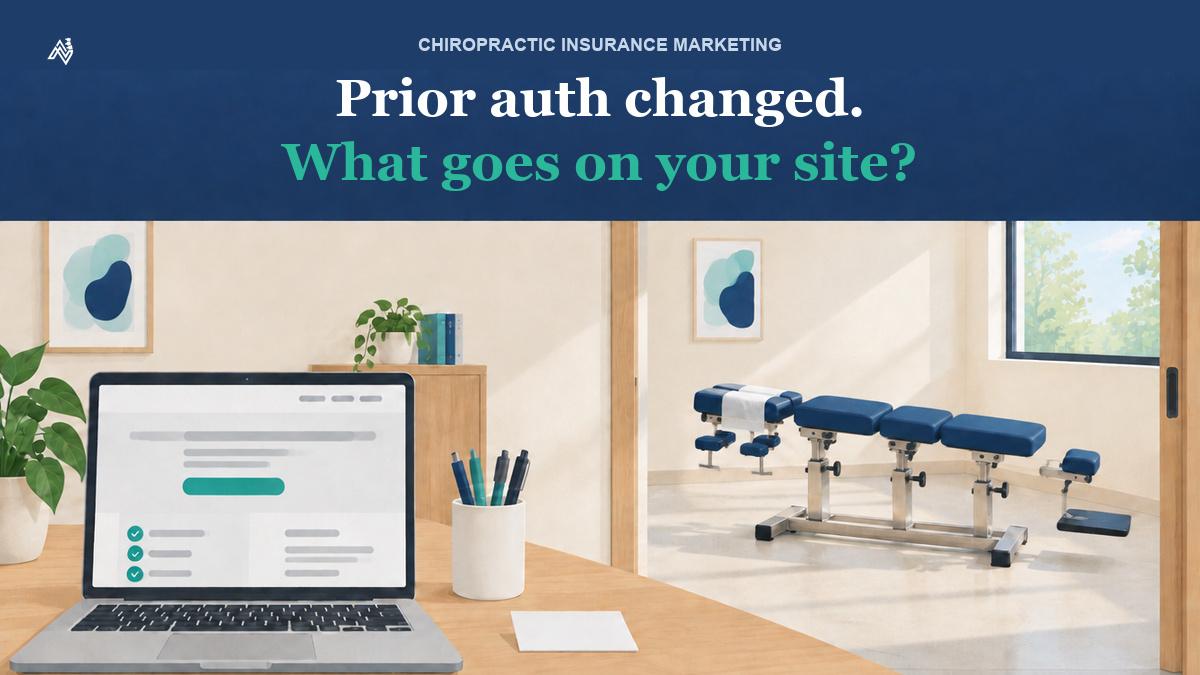
Not as news, and never as a coverage claim. Chiropractic insurance marketing works when it answers the question insured patients actually ask: do you take my plan? UnitedHealthcare's Oct. 1, 2026 change is narrow. Of the five code lists it published for the change, only the Medicare Advantage and D-SNP list includes chiropractic manipulation codes.
If your clinic is in network with insurers, the news can look like something worth sharing. It touches one plan family, patients don't search for it, and a prior authorization list says nothing about what a patient's plan pays. What does help is a clear answer to the plan question, on your website and in a few short films, with no promises in it.
We are ChiroVant, the team behind 183 films built for chiropractic clinics. This article is about marketing: what your insurance page and your posts say. What a plan requires or pays is a question for the UnitedHealthcare provider portal, your billing adviser or your state association. If you are weighing outside help for the content side, our page on chiropractic video marketing covers what we make.
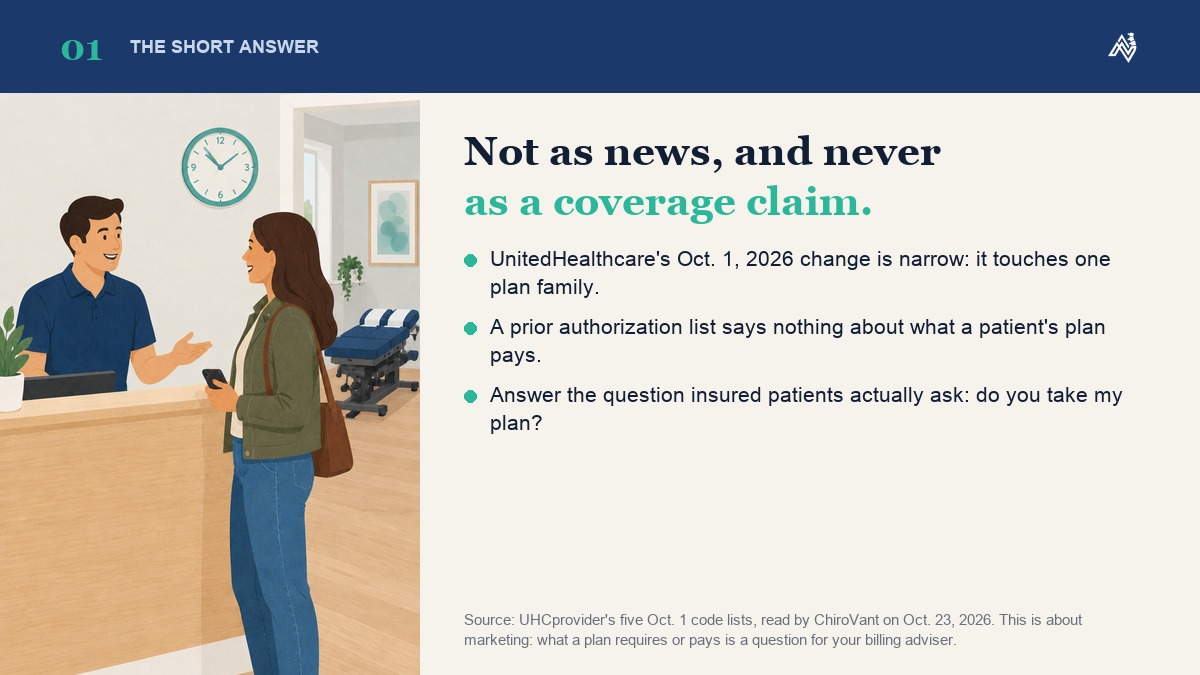
Table of Contents
What Changed in Prior Authorization for Chiropractic on Oct. 1?
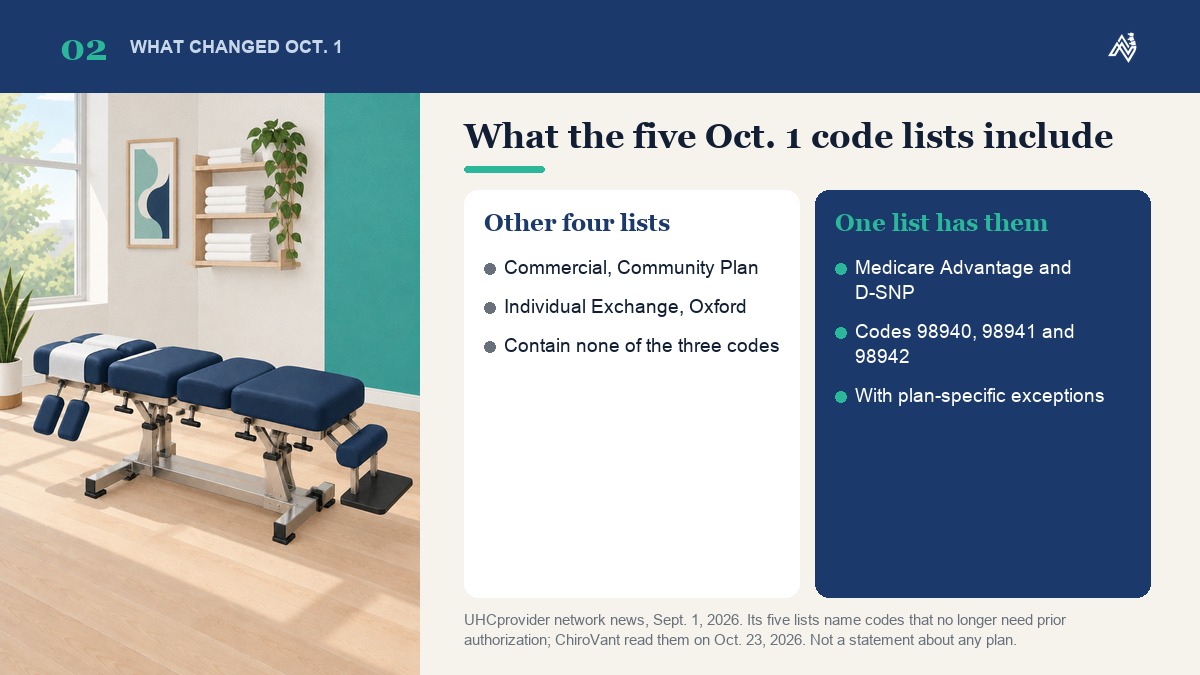
UnitedHealthcare's five Oct. 1 code lists, one per plan group, name codes that no longer need prior authorization, with plan-specific exceptions. Chiropractic manipulation codes 98940, 98941 and 98942 appear on only one: the Medicare Advantage and Dual Special Needs (D-SNP) list. The other four lists don't include them, which says nothing either way about what those plans require.
The announcement came first. In a UnitedHealth Group release of May 5, 2026, the company said that by the end of 2026 UnitedHealthcare would eliminate an additional 30% of remaining prior authorizations, including "certain outpatient therapies and chiropractic care," and that a full list would be posted on UHCProvider.com before the changes took effect.
The lists came in September. UHCprovider's network news item of Sept. 1, 2026 says that beginning Oct. 1, UnitedHealthcare is eliminating 30% of prior authorization requirements for its commercial, Medicare Advantage, Community Plan, Individual Exchange and Oxford plans, and it links one code list for each group.
We read all five lists on Oct. 23, 2026. Only the Medicare Advantage and D-SNP list includes the three chiropractic manipulative treatment codes, which cover spinal treatment of one to five regions. The commercial, Community Plan, Individual Exchange and Oxford lists contain none of them. That is what the lists contain, not a statement about any plan: the Medicare Advantage list itself says "for plan-specific exceptions, continue to verify requirements" through UnitedHealthcare's Prior Authorization and Advance Notification tool.
State associations explained the change to their members in September. The Kansas Chiropractic Association's notice of Sept. 7, for one, adds that providers should still verify benefits and plan-specific requirements before providing care. Your own state association is the place to read what it means for your clinic, and your billing adviser is the person to ask about your own claims.
Should Your Clinic Post About the Prior Authorization Change?
Not as a public news post, and never as a coverage line. The change sits on one plan family's list, a prior authorization list is not a statement of what a patient's plan pays, and patients don't search for it. Treat it as a front-desk update, and market the question patients do ask: do you take my plan?
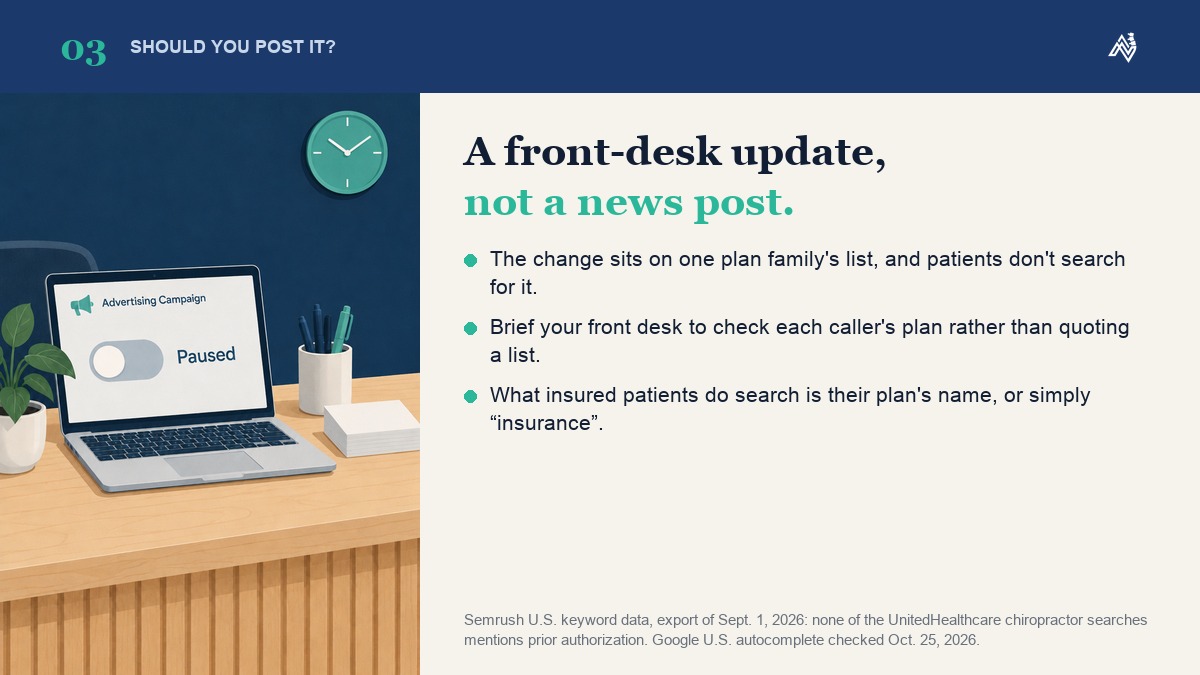
The search data points the same way. When we checked Google's U.S. autocomplete on Oct. 25, 2026, "uhc prior authorization changes" completed with searches such as "unitedhealthcare october prior authorization changes" and "uhc prior authorization list", which read like office and billing searches. And in Semrush's U.S. keyword data (export of Sept. 1, 2026), none of the UnitedHealthcare chiropractor searches mentions prior authorization.
So brief your front desk instead. The desk checks each caller's plan rather than quoting a list, the same habit our guide to chiropractic front desk training sets out for the insurance caller: confirm only what you can verify. Three lines this news tempts clinics to post, and that should stay off the feed:
- "No prior authorization needed." It depends on the patient's plan, and the plan is the one to say so.
- "UnitedHealthcare now covers chiropractic." A prior authorization list is not a coverage list.
- "No approval needed for Medicare patients." The list covers Medicare Advantage and D-SNP plans, not Medicare as a whole, and even there it points providers to plan-specific exceptions.
What insured patients do search is their plan's name, or simply "insurance". Semrush keyword data for the United States (export of Sept. 1, 2026) puts "aetna chiropractor" at about 720 searches a month, "chiropractor near me that takes insurance" at 590, "blue cross blue shield chiropractor" at 480 and "does united healthcare cover chiropractors" at 260. On Oct. 25, 2026, Google's autocomplete finished "in network chiropractor" with insurer names, and "chiropractic insurance accepted" with city names and clinic names.
In a Search post of Dec. 2, 2021, Google wrote that in the U.S., "finding a doctor who accepts your health insurance is often a top priority." For a national picture, an NBCE survey of 3,876 U.S. chiropractors (2024 data) found private health insurance was the second most common reimbursement category, at 37%. Respondents could select more than one category, so the categories overlap, and your own payer mix is the number that counts.
The takeaway for your marketing is simple: plan names are search words. Our guide to keywords for chiropractors recommends three or four question pages, cost and insurance among them, and your own website is where the plans you take belong.
Want us to do this for your clinic?
Want your clinic on every feed, every week, whether the ads are on or off? Get a quote: tell us about your clinic and the services you want on video, and we send a clear monthly price within one business day. No obligation, no contract.
Get a quote →What Should Chiropractic Insurance Marketing Say on Your Website?
One insurance page that names the plans your front desk has confirmed, says when the list was last checked, and explains how the clinic checks a patient's plan before the first visit. It answers the plan question in the patient's own words, and it promises nothing about what a plan pays.
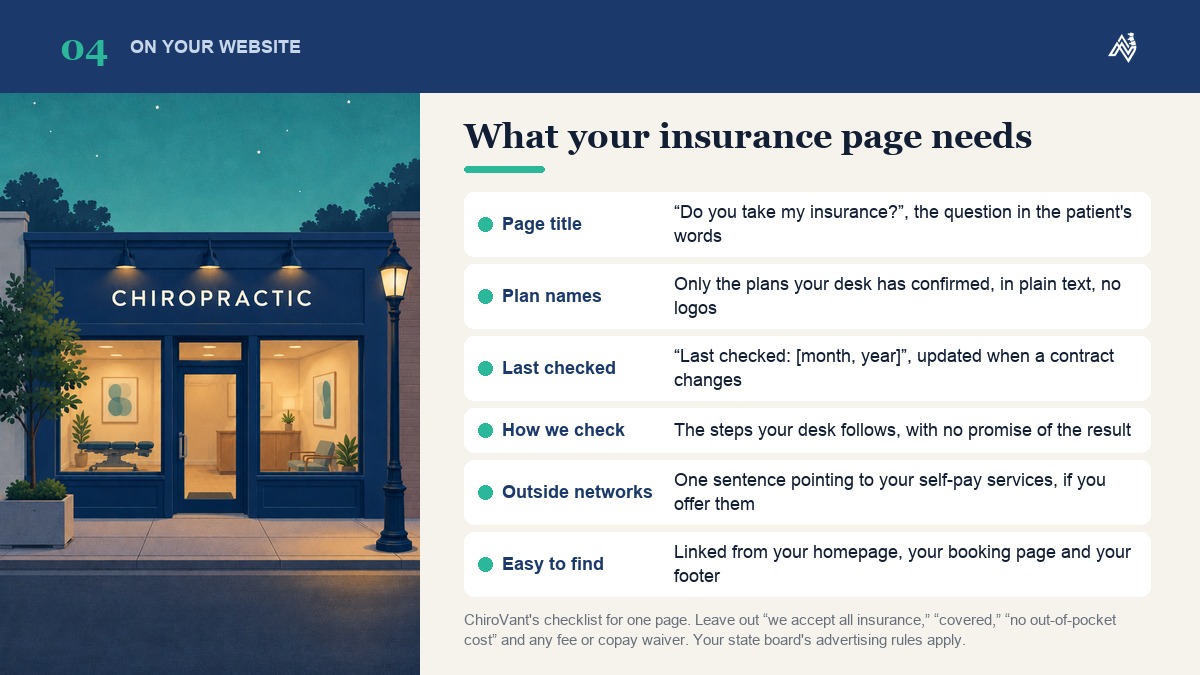
What the page needs:
- A heading in the patient's words. "Do you take my insurance?" is the question, so make it the title of the page.
- Plan names in plain text. List only the plans your desk has confirmed, by name, and leave insurer logos off.
- A "last checked" line. "Last checked: [month, year]" tells patients the list is current, and reminds your team to update it when a network contract changes.
- How we check your plan. The steps your desk follows, such as taking the plan details by phone or form and calling back before the first visit, with no promise of the result.
- A line for patients outside your networks. One sentence pointing to your self-pay services, if you offer them. Our guide to marketing a chiropractic cash practice covers that side.
- Easy to find. Link the page from your homepage, your booking page and your footer, and keep the first-contact form short: the plan details can wait for the call back.
Leave out "we accept all insurance," "covered," "no out-of-pocket cost" and any fee or copay waiver. Plans differ, and a web page can't know a patient's plan. If the page names Medicare Advantage plans, show it to your compliance adviser before it goes live. Your state board's advertising rules apply to the page too, and our guide to chiropractic advertising rules covers what to check before you publish.
Practice websites can carry legal requirements of their own. The Illinois Chiropractic Society, for example, published an article on required website elements on Oct. 21, 2026, so check what your own state association says before you rebuild the page. Adding the page is a job for your web team or website provider; what we make is the content that sends people to it.
Which Insurance Posts and Videos Help Patients Book?
Posts that explain the process, not posts that promise coverage. A short captioned film or card about how your front desk checks a plan, what to bring to a first visit or what to do after a plan change, each ending with "call us to check your plan," answers the patient's question without answering for the plan.
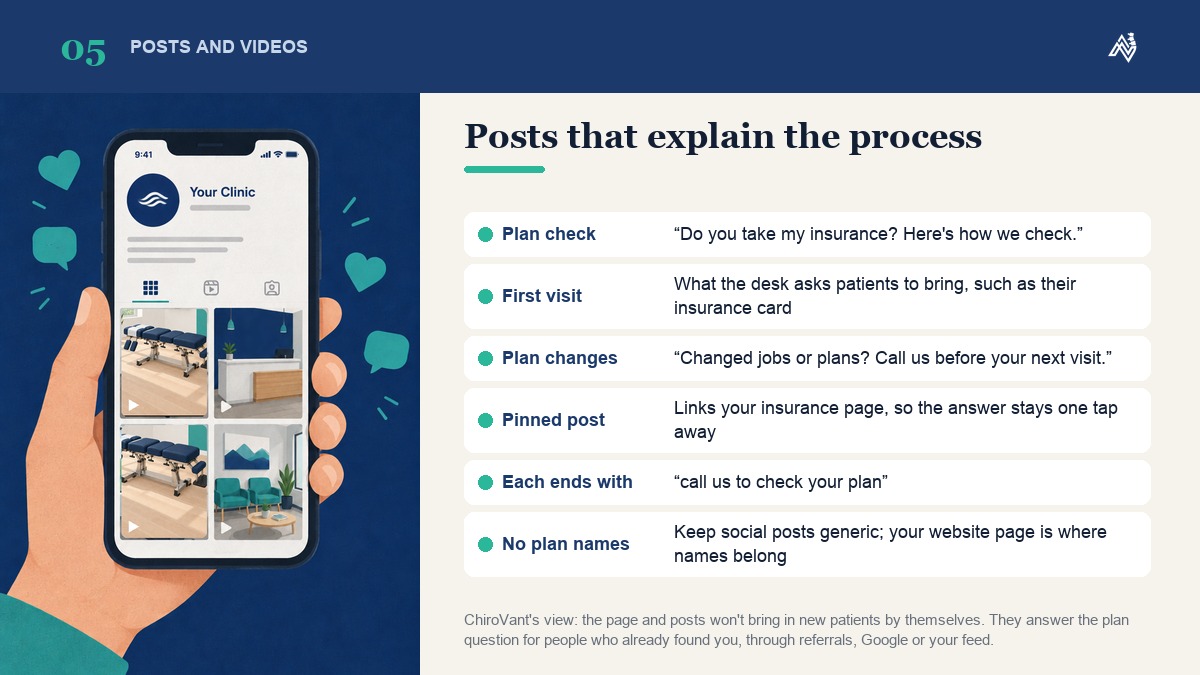
- "Do you take my insurance? Here's how we check." Call or fill in the form, the desk checks the plan, and the clinic calls back before the first visit.
- "Your first visit at the front desk." What your desk asks patients to bring, such as their insurance card, and what it does with it.
- "Changed jobs or plans? Call us before your next visit." The evergreen version of the open-enrollment posts in our guide to chiropractic holiday marketing: it works in any month.
- A pinned post. Pin a post or story highlight that links your insurance page, so the answer stays one tap away.
Keep the social posts generic, with no plan names. Networks change, and your website page, checked by your desk, is where the names belong. The posts send people there, or to the phone.
Will the page and the posts bring in new patients by themselves? No. They answer the plan question for people who already found you, through referrals, Google or your feed. Our guide on how to get new chiropractic patients puts it plainly: when ad budgets pause, patient acquisition stops, at least the part your ads were doing. An insurance page doesn't replace that flow. It answers "do you take my plan?" for everyone who finds you another way, and it keeps answering while the ads are off.
How Does ChiroVant Help an In-Network Clinic?
We focus on branding and content creation for organic growth: short branded videos, carousels and posts made with your logo, your services and your city. Videos are built from your website, so there is nothing to film; we produce with AI and review every frame by hand. You approve every script, and everything delivered is yours to keep.
For an in-network clinic, that can mean a "how we check your plan" film, a first-visit walkthrough and a pinned post that sends people to your insurance page, alongside films about the services patients ask about most. On Essential, at $249 a month, you get four videos, two carousels, four posts and one ad creative, with a calendar, and you post them. On Growth, at $449, we post for you on Instagram, Facebook, TikTok and YouTube once you have approved each piece. Authority, at $989, adds two local articles a month on your site and keeps your Google Business profile active, with review replies written for you. The full details are on our packs page.
Ad accounts, website builds and billing advice are not part of what we do, and no one can promise you results. What we can do is keep your clinic, and the way you check a plan, on every feed, every week.
Want us to do this for your clinic?
Pick the service patients ask about most. Ask us for a quote and we will tell you what a monthly set of short captioned films about it would cost for your clinic, within one business day.
Get a quote →This week, open your website on a phone the way a patient would and look for the answer to "do you take my insurance?" If it takes more than one tap, ask your web team for the page, have your desk confirm the plan list, and post one short film about how you check a plan. Then do the same next week, and if you want help keeping it going, get a quote.